If you ask ten people what root canal treatment is for, most of them will say the same thing: “it’s for when your tooth is basically done for.” That’s the general belief, and honestly, it’s not surprising. Root canal has a bit of a reputation. People hear the term and immediately picture the worst-case scenario, a tooth so damaged that pulling it out feels like the only sensible option, with RCT as some kind of desperate, painful, last-ditch effort before extraction.
But here’s the thing. That idea is outdated, and it’s actually keeping a lot of people from getting help at the right time.
If you’re searching for RCT in Warje, chances are you’re dealing with a tooth that’s been bothering you, maybe on and off, maybe just a dull ache when you bite down, maybe some sensitivity to hot or cold that comes and goes. And because you don’t think it’s “bad enough” yet, you’re putting it off. This blog is here to explain why that thinking, while completely understandable, might actually be working against you.
The Real Purpose of Root Canal Treatment
Let’s clear up the biggest myth first: root canal treatment is not a way to save a tooth that’s already lost. It’s a way to save a tooth before it gets to that point.
What Causes a Tooth Infection
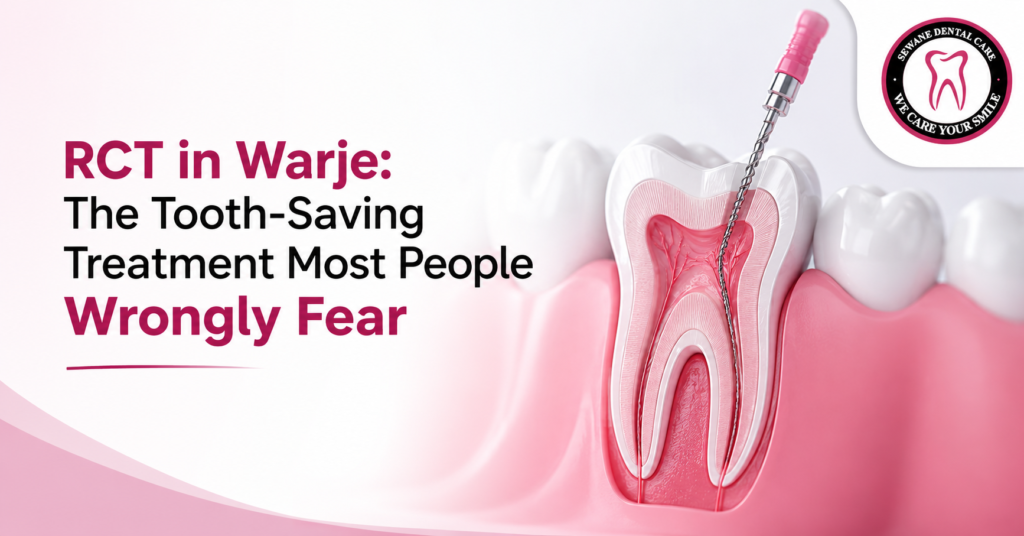
Every tooth has a soft tissue inside it called pulp. This pulp contains nerves and blood vessels, and it’s what keeps your tooth alive and connected to the rest of your body. When bacteria manage to get inside usually through a deep cavity, a crack, or an old filling that’s broken down, that pulp gets infected. Once infected, it can’t heal on its own. It just gets worse.
How Root Canal Treatment Fixes It
This is where root canal treatment steps in. The dentist removes the infected pulp, cleans out the inside of the tooth thoroughly, and then seals it up so bacteria can’t get back in. The tooth itself, the hard outer structure, the root, the part that’s anchored into your jawbone, stays exactly where it is. You keep your natural tooth instead of replacing it with an implant or a bridge, and nothing gets extracted. The dentist simply removes the sick part and protects what’s healthy.
That’s the whole point of RCT. It’s not a defeat. It’s a rescue.
Why Timing Changes Everything
Here’s something most people don’t realize: root canal treatment works best when it’s done early, while the root is still strong and the bone around the tooth is still healthy.
The Roof Leak Analogy
Think of it like this. If you catch a small leak in your roof, you patch it up and you’re done in an hour. But if you ignore that leak for months, water keeps seeping in, the wood underneath starts to rot, and now you’re not just patching a hole you’re replacing a chunk of the structure. The problem didn’t change in nature. It just got a lot bigger and a lot more complicated because time was allowed to work against it.
What Delay Does to Your Tooth
Your tooth is no different. A tooth with an early-stage infection is usually a straightforward case. The root is intact, the bone around it hasn’t been affected, and root canal treatment can resolve the issue in a fairly simple, predictable way. But if that same infection is left alone for weeks or months, it can spread down into the root and out into the surrounding bone. At that stage, treatment becomes more complex, sometimes involving additional procedures, and in some cases, the tooth may not be salvageable at all.
So when people delay treatment because they think RCT is only needed for “really bad” teeth, they’re often creating the exact situation they were trying to avoid, one where saving the tooth becomes much harder, or even impossible.
The On-and-Off Pain Trap
Why Pain Comes and Goes
One of the trickiest parts of dental infections is that pain doesn’t behave in a straight line. It doesn’t just steadily get worse until you can’t ignore it anymore. Sometimes it flares up for a day or two and then completely disappears for weeks. This is incredibly misleading, because it feels like the problem has resolved itself.
What It Really Means When the Pain Stops
It hasn’t. When pain suddenly disappears in a tooth that was clearly hurting before, it can actually mean the nerve inside has died. Without a live nerve, you stop feeling the day-to-day discomfort, but the infection is often still very much active, quietly working its way toward the bone. The absence of pain, in this case, isn’t good news. It’s just a different phase of the same problem.
This is exactly why “it doesn’t hurt as much anymore, so I’ll just leave it” is one of the most common ways people end up needing more extensive treatment than they would have otherwise. If a tooth has been aching on and off, that pattern itself is worth paying attention to, not waiting out.
What Actually Happens During RCT
A lot of the fear around root canal treatment comes from stories that are, frankly, decades old. Modern RCT, done by an experienced hand, is a controlled, methodical procedure, not the horror story people picture.
Step-by-Step: How the Procedure Works
In simple terms, here’s what it involves:
- The dentist numbs the area so you don’t feel pain during the procedure.
- The dentist makes a small opening in the tooth to reach the infected pulp.
- The dentist carefully removes the infected tissue from inside the tooth and its root canals.
- The dentist cleans and shapes the empty space to clear out bacteria.
- The dentist fills and seals the space to prevent reinfection.
- In most cases, the dentist places a crown afterward to protect and strengthen the tooth for the long run.
Why Experience Matters in RCT
That’s it. It’s precise work, and it does require skill and experience to do properly, especially since root canals inside a tooth can be narrow and complex in shape. This is where experience really matters, a dentist who has handled thousands of these cases over the years develops a much finer sense of how to navigate tricky canal anatomy, avoid complications, and get the job done efficiently. Dr. Sagar Sewane brings over 18 years of hands-on experience to this exact kind of work, which matters a great deal when you’re trusting someone with saving your natural tooth.
If you want to understand the more advanced, precision side of this procedure, it’s worth reading about microscopic root canal treatment, where magnification is used to treat even the most complicated canal structures with much greater accuracy.
Why “Waiting It Out” Rarely Pays Off
There’s a common instinct to wait and see. Maybe the pain will just go away. Maybe it’s not as serious as it feels. This instinct makes sense, nobody wants to rush into dental treatment unless they’re sure it’s necessary.
But dental infections don’t work like a common cold. They don’t run their course and disappear on their own. Left untreated, an infected tooth almost always moves in one direction: worse. It might take weeks, it might take months, but the outcome tends to be the same, more bone loss, more risk to the tooth, more discomfort down the line, and often, more complicated (and more expensive) treatment when you finally do see a dentist.
What You Gain by Treating It Early
Catching it early doesn’t just save the tooth. It usually means:
- A simpler, shorter procedure
- Less discomfort overall
- Lower treatment cost compared to delayed or complex cases
- A stronger chance of the tooth lasting for years afterward
- No need for extraction, implants, or bridges
In other words, the “wait and see” approach almost never saves you time or money. It usually costs more of both.
Why Local, Experienced Care Matters
Root canal treatment isn’t a one-size-fits-all procedure. Every tooth is a little different, some roots are straight and simple, others curve in unpredictable ways, and some have extra canals that are easy to miss if you’re not looking carefully. This is exactly why experience counts for so much.
Why Choose Sewane Dental Care for RCT in Warje
Sewane Dental Care, located on Warje Road in Warje, has built its reputation around exactly this kind of precise, patient-first dental work. If you’re looking for reliable RCT in Warje, having a dentist nearby who you can see quickly, rather than waiting weeks for an appointment somewhere far away, makes a real difference when a tooth is already giving you trouble. You can explore Sewane Dental Care’s full range of dental treatments to see how the clinic approaches patient care.
For a deeper look at how microscopic precision is used specifically for complex root canal cases in this area, this detailed guide on microscopic root canal treatment in Warje is a helpful read.
So, When Should You Actually Get It Checked?
You don’t need to wait for unbearable pain to see a dentist. In fact, waiting for that point is often exactly the mistake this whole article is about.
Signs You Shouldn’t Ignore
Some signs that it’s time to get a proper check-up include:
- A tooth that hurts on and off, even mildly
- Sensitivity to hot or cold that lingers longer than a few seconds
- Pain when you bite or chew
- A tooth that suddenly stopped hurting after a period of noticeable discomfort
- Slight swelling or tenderness in the gum near a specific tooth
- Darkening of a tooth compared to the ones around it
None of these symptoms mean you definitely need a root canal. But they do mean it’s worth getting looked at, so a dentist can tell you where things actually stand while your options are still simple. If it turns out you do need RCT, catching it at this stage is usually the easiest and most affordable time to deal with it.
If any of this sounds familiar, it’s worth reaching out sooner rather than later. You can book a root canal consultation with Sewane Dental Care, or find directions to the clinic on Warje Road if you’d like to just walk in and get it checked.
Final Thoughts
Root canal treatment has an image problem, not a performance problem. It’s not the last resort people assume it is, it’s actually one of the best tools dentistry has for keeping your natural teeth in your mouth, doing their job, for years to come. The catch is that it works best when it’s done at the right time, not after the situation has already worsened.
If a tooth has been quietly bothering you, don’t wait for it to become an emergency. Getting it looked at now, while the root and bone are still healthy, gives you the best possible outcome, a saved tooth, a simpler procedure, and one less thing to worry about.
Frequently Asked Questions
Not really. The dentist numbs the area with local anesthesia, so you shouldn’t feel pain during the treatment. Most people report that it feels similar to getting a regular filling done. Some mild soreness afterward is normal and usually settles within a day or two.
This depends on how deep the decay or infection has gone. A filling works when the damage hasn’t reached the pulp. If the infection has reached the pulp, a filling alone won’t fix it, and root canal treatment becomes necessary. The only way to know for sure is to get the tooth examined.
Sometimes, yes — but not always. Pain stopping suddenly can mean the nerve has died, and the infection may still be active. It’s important to get this checked quickly, because the window to save the tooth can close if it’s left too long.
Most dentists complete root canal treatment in one to two visits, depending on the complexity of the tooth and how many canals it has. Simpler cases can sometimes finish in a single sitting.
Yes, in most cases. Once the dentist removes the infected pulp and seals and caps the tooth with a crown, it can function normally for many years, sometimes for life, with regular care and hygiene.
The infection typically spreads further into the root and surrounding bone. This can lead to more pain, swelling, bone loss, and in some cases, the tooth may no longer respond to RCT, so the dentist might need to extract it.
Sewane Dental Care on Warje Road offers experienced root canal treatment, led by Dr. Sagar Sewane, who has over 18 years of experience in the field. You can get directions to Sewane Dental Care on Warje Road or schedule your root canal appointment here.

Dr. Sagar Sewane
Dr. Sagar Sewane, the driving force behind Sewane Dental Care & Implant Centre, is a highly experienced dentist with over 18 years of dedicated practice. He graduated from Amravatii Dental College and further specialized in Periodontology and Implantology with a Masters (MDS) from Mumbai. Dr. Sewane is passionate about providing comprehensive and personalized dental care to his patients, utilizing his extensive knowledge and experience to ensure the highest quality of care in a comfortable and welcoming environment.