KEY TAKEAWAYS
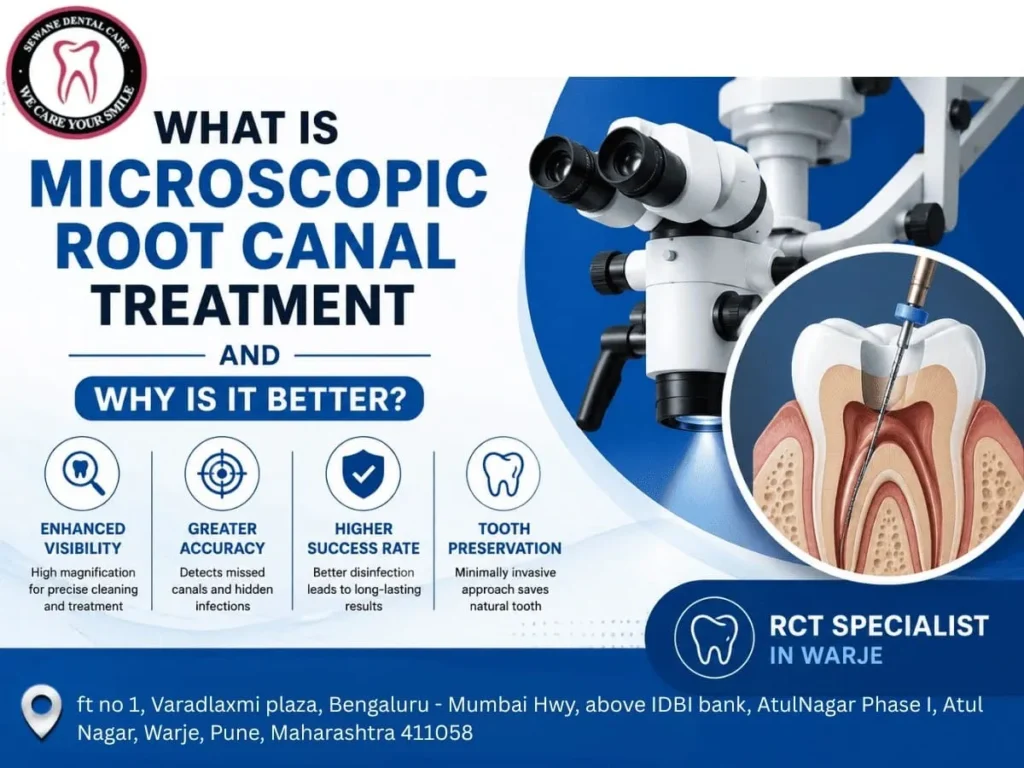
- Microscopic RCT uses a dental operating microscope at 4 to 25x magnification — giving the dentist precision impossible with the naked eye.
- Microscopic RCT achieves a success rate of 95 to 98% compared to 85 to 90% with conventional technique, a clinically significant difference.
- The most common cause of root canal failure is a missed canal, detectable only under magnification.
- Microscopic technique is more conservative less healthy tooth structure is removed during access and shaping.
- Dr. Sagar Sewane is one of the few RCT specialists in Warje performing microscopic root canal treatment as a standard procedure.
- Cost of microscopic RCT in Warje, Pune ranges from INR 6,000 to 14,000 depending on the number of canals.
- Microscopic RCT is the global standard of care in endodontics and the gold standard at Sewane Dental Care.
Introduction
Microscopic root canal treatment in Warje at Sewane Dental Care is not an upgrade or a premium add-on, it is the standard of care. Dr. Sagar Sewane, BDS, MDS (Periodontics), performs every root canal treatment under a dental operating microscope. The difference this makes to the quality of treatment, the detection of missed canals and the long-term success of the procedure is well-documented in the clinical literature. If you’ve been told you need a root canal in Warje, understanding why microscopic technique matters is essential before choosing your provider.
Quick Facts: Microscopic RCT in Warje, Pune
| Metric | Data |
| Microscopic RCT success rate | 95 to 98% (PubMed review) |
| Conventional RCT success rate | 85 to 90% (PubMed review) |
| Magnification level | 4x to 25x during procedure |
| Cost in Warje, Pune | INR 6,000 to 14,000 per tooth |
| Missed canal rate (conventional) | Up to 15% of molar cases (Industry estimate) |
| Missed canal rate (microscopic) | < 3% (Industry estimate) |
Warje Pune: Microscopic RCT Statistics 2025-2026
| Metric | Data Point | Source |
| Microscopic RCT success rate | 95 to 98% | PubMed endodontic review 2022 |
| Conventional RCT success rate | 85 to 90% | PubMed comparison data |
| Missed canal in conventional molar RCT | Up to 15% | Industry estimate |
| Missed canal in microscopic molar RCT | < 3% | Industry estimate |
| RCT procedures in India annually | ~15 million | Industry estimate |
| Clinics in Warje area offering microscopic RCT | < 5% | Industry estimate |
| Microscopic RCT cost Pune average | INR 6,000 to 14,000 | Industry estimate |
What Is a Dental Operating Microscope?
A dental operating microscope (DOM) is a precision optical instrument mounted on an adjustable arm in the operatory that provides coaxial illumination and magnification at 4x to 25x of the surgical field. The dentist looks through the eyepiece with both hands free to work, unlike loupes, which are worn on glasses and offer only 2.5x to 3.5x magnification.
At 4x to 25x magnification, structures completely invisible to the naked eye become clear: extra canals in apparently single-canal teeth, hairline cracks in the pulp chamber floor, incompletely filled areas at the root tip, calcified canal entrances and microbial biofilm patterns in infected canals.
Why Does Magnification Matter So Much in Root Canal Treatment?
Canal Detection
Human tooth anatomy frequently deviates from textbook norms. An upper first molar routinely taught as having 3 canals often has 4, the second mesiobuccal canal (MB2) is present in 50 to 90% of upper first molars but missed in conventional RCT at high rates. Under a microscope, this canal is identified and treated. Without a microscope, it may be missed, leaving residual infection that causes failure months to years later.
Precision and Conservation
Conventional RCT requires a larger access cavity to compensate for limited vision. Microscopic technique allows a minimally invasive access design, preserving more tooth structure. More remaining tooth structure means a stronger post-RCT tooth with a lower fracture risk over time.
Crack Detection
Hairline cracks in the pulp chamber floor or root are invisible on X-rays and invisible without magnification. A cracked tooth cannot be saved with RCT, it requires extraction and implant. Under the microscope, cracks are identified before treatment proceeds, saving the patient from undergoing a root canal on a tooth that cannot ultimately be saved.
Better Disinfection
Seeing the canal system clearly means all infected tissue is removed more thoroughly. Irrigating solutions like sodium hypochlorite reach every corner of the canal system when the clinician can visualise precisely where they’re working.
Microscopic vs Conventional RCT: Comparison
| Factor | Microscopic RCT | Conventional RCT |
| Magnification | 4x to 25x | Naked eye or 2.5x loupes |
| Success rate | 95 to 98% | 85 to 90% |
| MB2 canal detection rate | > 97% | 50 to 60% |
| Access cavity size | Smaller and more conservative | Larger to compensate for limited vision |
| Crack detection | Yes, with clear illumination | Very limited |
| Cost in Warje | INR 6,000 to 14,000 | INR 4,500 to 9,000 |
Post-Treatment Oral Hygiene After Microscopic RCT
Microscopic RCT preserves more tooth structure, giving the post-treatment tooth greater strength before crown placement. Nevertheless, a dental crown remains essential for back teeth to prevent fracture under biting forces. Don’t delay the crown appointment, the temporary filling is not designed for long-term load bearing.
Brush twice daily and floss daily around the treated tooth from day one after the procedure. There are no special diet restrictions beyond the first 24 to 48 hours of mild soreness. At your crown appointment, Dr. Sewane checks the seal at the gum margin to prevent any future coronal leakage.
Microscopic RCT in Warje: Local Context
Sewane Dental Care in Warje is one of the few practices in Pune’s western suburbs that routinely performs every root canal under a dental operating microscope, not as an exceptional service for complex cases but as the daily standard for every single patient. Most dental clinics in India still perform RCT without magnification or with only basic loupes.
A patient from Dhayari had been told by two previous clinics that her upper first molar’s root canal had been ‘completely done’ three years earlier. She came to Sewane Dental Care with persistent low-level pain. Under the microscope, Dr. Sewane identified an entirely untreated MB2 canal with an active periapical lesion. Microscopic Re-RCT resolved her pain completely within 6 weeks.
Frequently Asked Questions
A: Microscopic RCT provides 4 to 25x magnification, allowing detection of missed canals, hairline cracks and incomplete fills that are invisible to the naked eye. The success rate with microscopic technique is 95 to 98% versus 85 to 90% with conventional RCT, a 10% improvement in outcomes that directly affects whether you keep or lose the tooth.
A: No. Dental operating microscopes are expensive and require specific training to use effectively. Sewane Dental Care in Warje is one of very few clinics in the western Pune suburbs that performs microscopic RCT as a standard procedure for every patient, not only for complex retreatment cases.
A: The cost of microscopic RCT in Warje is INR 6,000 to 14,000 compared to INR 4,500 to 9,000 for conventional RCT. The higher cost reflects the equipment, specialist training and significantly better success rates. Given that a failed conventional RCT requires retreatment or extraction and an implant, the cost difference is minimal in long-term perspective.
A: No. The procedure is performed under local anaesthesia regardless of technique. The microscope affects what the dentist sees, not what the patient feels. Most patients at Sewane Dental Care report that their microscopic RCT was no different in sensation from a routine filling procedure.
A: Most single-canal and premolar cases are completed in one session of 60 to 90 minutes. Multi-canal molar cases with active infection may require 2 sessions. The microscope allows more efficient and complete treatment per session, which often means fewer total visits than conventional multi-session
Conclusion
Microscopic root canal treatment in Warje at Sewane Dental Care is not just better, it’s definitively better, backed by clinical success rates that conventional technique cannot match. When you choose Dr. Sagar Sewane for your RCT, you’re choosing a specialist who sees what other dentists miss. Book your RCT consultation at sewanedentalclinic.com today. Serving patients from Warje, Kothrud, Bavdhan and Dhayari with specialist-standard endodontic care.

Dr. Sagar Sewane
Dr. Sagar Sewane, the driving force behind Sewane Dental Care & Implant Centre, is a highly experienced dentist with over 18 years of dedicated practice. He graduated from Amravatii Dental College and further specialized in Periodontology and Implantology with a Masters (MDS) from Mumbai. Dr. Sewane is passionate about providing comprehensive and personalized dental care to his patients, utilizing his extensive knowledge and experience to ensure the highest quality of care in a comfortable and welcoming environment.