KEY TAKEAWAYS
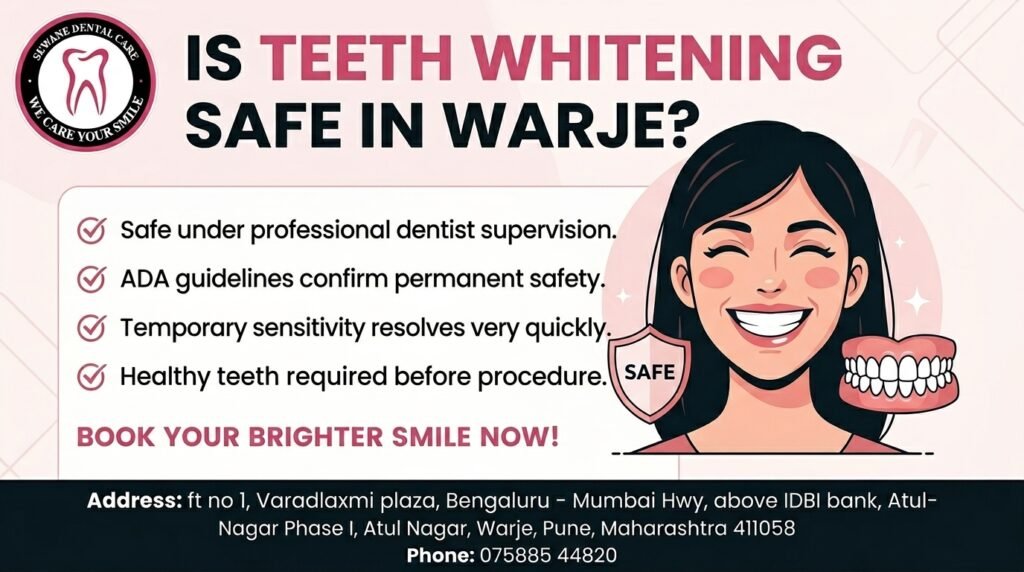
- Professional teeth whitening supervised by a dentist is safe for enamel when protocols are followed correctly.
- Hydrogen peroxide concentrations used in professional in-office whitening (25 to 40%) are significantly higher than OTC products (3 to 10%) but safer because they are applied with gum protection and professional oversight.
- Post-whitening sensitivity affects approximately 30% of patients and is temporary, typically resolving within 24 to 48 hours.
- Patients with active cavities, exposed dentine or gum disease should not undergo whitening until these are treated.
- Over-the-counter whitening strips used without dental supervision are associated with a higher risk of enamel demineralisation and gum irritation.
- Professional whitening at Sewane Dental Care in Warje includes a pre-treatment check, cavity assessment and desensitising protocol.
- Whitening does not damage existing crowns or veneers but will not change their colour.
Introduction
Is teeth whitening safe in Warje? This is one of the most asked cosmetic dentistry questions at Sewane Dental Care, and it deserves a clear, evidence-based answer. Yes — professional teeth whitening performed by a qualified dentist is safe for dental enamel when appropriate protocols are followed. The concern is not professional whitening but rather unregulated at-home products used without dental assessment. Dr. Sagar Sewane, BDS, MDS (Periodontics), explains the real safety facts, who should avoid whitening and why the pre-treatment check at a dental clinic in Warje is not optional.
Quick Facts: Teeth Whitening Safety in Warje, Pune
| Metric | Data |
| Recommended hydrogen peroxide concentration (professional) | 25 to 40% with gum protection |
| OTC strip concentration | 3 to 10% without professional oversight |
| Temporary post-whitening sensitivity | ~30% of patients, resolves in 24 to 48 hours |
| Enamel damage from supervised whitening | Not clinically demonstrated at standard concentrations (ADA) |
| Patients who should avoid whitening | Active cavities, gum disease, exposed dentine, pregnancy |
| Whitening on crowns or veneers | Does not whiten existing restorations |
Warje Pune: Teeth Whitening Safety Statistics 2025-2026
| Metric | Data Point | Source |
| OTC whitening market growth India | ~20% annually | Industry estimate |
| Patients with post-whitening sensitivity | ~30% | PubMed cosmetic dentistry review |
| ADA position on professional whitening safety | Safe when dentist-supervised | ADA guidelines |
| Enamel surface change from OTC strips | Micro-surface roughness increase | PubMed 2023 |
| Gum irritation from OTC tray misfit | ~40% of self-applied users | Industry estimate |
| Professional whitening efficacy vs OTC | 4-8 shades vs 1-3 shades improvement | Industry estimate |
| Patients with undiagnosed cavities pre-whitening | ~15% of walk-in cosmetic seekers | Industry estimate |
How Does Teeth Whitening Work?
Hydrogen peroxide (or its precursor carbamide peroxide) penetrates through the enamel and breaks down the long-chain chromogen molecules responsible for staining. The bleaching oxidation reaction effectively clears colour from within the tooth structure — not just on the surface. This is why whitening works on intrinsic yellowing as well as surface stains.
In professional in-office whitening at Sewane Dental Care in Warje, a high-concentration gel (25 to 40% hydrogen peroxide) is applied after isolating the gums with a protective dam or liquid rubber barrier. An LED or plasma arc light may be used to activate the gel. Multiple cycles of 15 to 20 minutes achieve the maximum shade improvement in a single session.
Is Professional Whitening Safe for Enamel?
At the concentrations and application times used in a professional setting, no permanent enamel damage has been demonstrated in controlled clinical studies. The American Dental Association (ADA) states that professionally supervised whitening is safe when performed according to established protocols.
Enamel temporarily becomes more porous during the whitening process as the oxidation reaction occurs. This is why the 48-hour ‘white diet’ window after treatment matters — the enamel pores reseal, but are more susceptible to re-staining immediately after treatment. Fluoride varnish application after whitening accelerates remineralisation of the enamel surface.
Professional vs OTC Whitening: Safety Comparison
| Factor | Professional Whitening | OTC Strips or Kits |
| Pre-treatment cavity check | Yes — mandatory at Sewane Dental Care | None |
| Gum protection | Yes — barrier gel or rubber dam | None |
| Peroxide concentration | 25 to 40% (controlled use) | 3 to 10% (unregulated self-use) |
| Post-whitening desensitising | Yes — fluoride varnish applied | Not typically included |
| Shade improvement | 4 to 8 shades | 1 to 3 shades |
| Risk of gum irritation | Minimal with proper barrier | ~40% reported in studies |
| Supervision | Dental specialist oversight | No professional oversight |
Who Should Not Get Teeth Whitening?
Active Cavities
Whitening gel penetrates through cavities directly to the pulp, causing severe sensitivity or pulp irritation. All cavities must be filled before whitening proceeds. This is why the pre-whitening check-up at Sewane Dental Care is essential, not optional.
Gum Disease
Inflamed gum tissue is highly sensitive to whitening gel. Whitening on untreated gingivitis or periodontitis causes significant gum pain and can worsen inflammation. Gum treatment and stabilisation must precede cosmetic whitening.
Exposed Dentine
Patients with significant gum recession exposing root surfaces cannot undergo standard whitening protocols without managing sensitivity first. Root surfaces have no enamel protection and react painfully to whitening gel.
Pregnancy
Whitening is not recommended during pregnancy due to the absence of safety data for hydrogen peroxide use in pregnant patients. Elective cosmetic procedures including whitening are deferred until after delivery and breastfeeding completion.
Children and Teenagers Under 16
Tooth development and pulp size in younger patients make whitening inadvisable before all permanent teeth are fully erupted and the pulp has matured. The recommended minimum age is 16 years with parental consent.
Managing Post-Whitening Sensitivity
If you experience sensitivity after whitening at Sewane Dental Care in Warje, it typically feels like brief sharp twinges when breathing cold air or eating cold foods. This is caused by temporary dentinal tubule exposure from enamel pore opening during the whitening process. Fluoride varnish applied immediately after the whitening session at Sewane Dental Care significantly reduces this response.
At home, use a sensitivity-formulated toothpaste with potassium nitrate or stannous fluoride for the first 1 to 2 weeks after whitening. Avoid extreme temperature foods for 48 hours. If sensitivity persists beyond 5 to 7 days, contact Sewane Dental Care for a review.
Teeth Whitening Safety in Warje: Local Context
Many patients visiting Sewane Dental Care in Warje have tried OTC whitening products from online platforms before coming in. The most common complaints include uneven whitening, gum burning and returning staining within weeks. The trays in OTC kits are not custom-fitted, which means the whitening gel contacts the gum tissue repeatedly. A custom-fitted professional tray or the in-office procedure with proper gum protection avoids this entirely.
For patients in Kothrud, Bavdhan and Dhayari considering whitening before a Diwali, wedding or job event, Dr. Sewane recommends booking 2 to 3 weeks in advance — allowing time for the check-up, any necessary preparatory treatment and then the whitening session itself.
Frequently Asked Questions
Q: Does teeth whitening damage enamel permanently?
A: Professional teeth whitening supervised by a dentist does not cause permanent enamel damage when performed according to established protocols. Temporary enamel porosity during treatment closes within 24 to 48 hours. The ADA confirms supervised professional whitening is safe for enamel.
Q: How long does sensitivity last after whitening?
A: Sensitivity typically resolves within 24 to 48 hours for most patients. In some cases with more reactive teeth, mild sensitivity may last 3 to 5 days. The fluoride varnish applied after your whitening session at Sewane Dental Care in Warje significantly reduces the intensity and duration of post-whitening sensitivity.
Q: Is it safe to whiten teeth at home with strips?
A: OTC whitening strips are generally safe when instructions are followed by adults without active dental disease. However, they provide less dramatic results (1 to 3 shades vs 4 to 8 shades professionally) and carry a higher gum irritation risk because trays aren’t custom-fitted. A dentist check before any whitening is the safest approach.
Q: Can I whiten my teeth if I’m pregnant?
A: No. Elective cosmetic whitening is not recommended during pregnancy due to the lack of safety data on hydrogen peroxide exposure for pregnant patients. Whitening can safely be performed after delivery and after breastfeeding is complete.
Q: How often can I safely get teeth whitened in Warje?
A: Professional in-office whitening is typically recommended no more than once every 12 months. Touch-up sessions with a take-home kit can be used every 6 months to maintain colour. Whitening more frequently than recommended increases the risk of surface sensitivity over time.
Conclusion
Teeth whitening is safe in Warje when performed professionally at Sewane Dental Care by Dr. Sagar Sewane. The pre-treatment check, cavity assessment, gum protection and post-whitening fluoride application are what separate a safe, effective in-office whitening from the risks of unsupervised OTC use. If you’re ready for a brighter smile and want to do it safely, book your whitening consultation at sewanedentalclinic.com. Serving Warje, Kothrud, Bavdhan and Dhayari.

Dr. Sagar Sewane
Dr. Sagar Sewane, the driving force behind Sewane Dental Care & Implant Centre, is a highly experienced dentist with over 18 years of dedicated practice. He graduated from Amravatii Dental College and further specialized in Periodontology and Implantology with a Masters (MDS) from Mumbai. Dr. Sewane is passionate about providing comprehensive and personalized dental care to his patients, utilizing his extensive knowledge and experience to ensure the highest quality of care in a comfortable and welcoming environment.